Journal · Safety news
Does tirzepatide carry FDA’s new NAION eye warning?
FDA now requires every approved GLP-1 label to warn of a rare optic-nerve condition. We read the November 9 notice from the tirzepatide side: which products it covers, what the numbers mean in absolute terms, and what to do the same day if symptoms start.
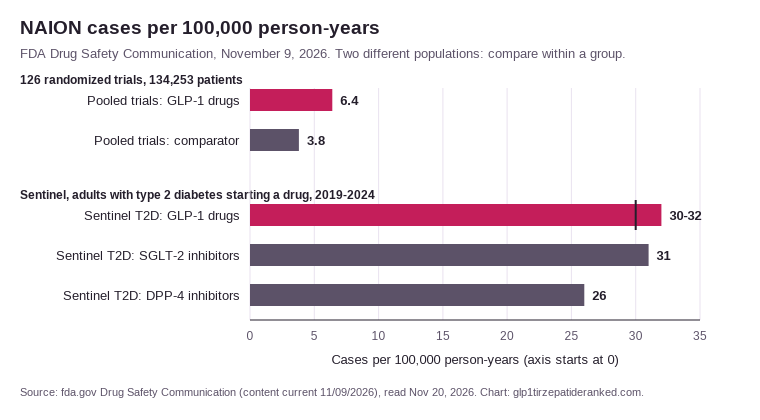
Yes for the FDA-approved products. On November 9, 2026, FDA required every GLP-1 receptor agonist label, including Mounjaro, Zepbound and Foundayo, to warn of a potential increased risk of NAION, a rare optic-nerve condition. Its trial analysis found 6.4 versus 3.8 cases per 100,000 person-years. Compounded tirzepatide has no FDA label to change.
Takeaway: The added risk is small in absolute terms, about 2.6 extra cases per 100,000 person-years in FDA’s pooled trials, but sudden, painless vision loss in one eye is a same-day call to a clinician, whichever tirzepatide you take.
What FDA announced on November 9, 2026
FDA’s Drug Safety Communication of November 9, 2026 tells patients and clinicians about “a potential increased risk of non-arteritic anterior ischemic optic neuropathy (NAION)” with GLP-1 receptor agonists. NAION is damage to the front of the optic nerve from reduced blood flow. FDA describes it as a rare condition that can cause “acute, painless, decreased vision in one eye, including permanent vision loss.”
The action is a labeling requirement. FDA is “requiring application holders for all GLP-1 RA medications to add information to the Warnings and Precautions section of labeling.” Nothing was withdrawn, no dose was changed, and FDA did not tell anyone to stop treatment. The label wording comes from each manufacturer. When we checked Lilly’s label site for this article, the Zepbound and Mounjaro prescribing information, both marked “Revised: 11/2026”, already listed “Unilateral Decrease or Loss of Vision: NAION” as Warning 5.9, while the Foundayo label there was still marked “Revised: 07/2026” without it.
Tirzepatide is on the list twice. FDA’s table names Mounjaro (approved 2022) and Zepbound (approved 2023), with a footnote that tirzepatide acts on both the GIP and GLP-1 receptors. Lilly’s oral drug Foundayo (orforglipron, approved 2026) is listed too. For anyone weighing a Lilly product, the warning therefore covers the injectable and the pill alike.
Which tirzepatide-family products the warning covers
The table below takes the Lilly rows from FDA’s list and adds what each one is approved for and how it reaches patients who pay cash. It shows where the new warning lands and where it cannot.
| Product | Molecule and route | FDA approval year | Gets the new warning? | Self-pay starting price | Source |
|---|---|---|---|---|---|
| Mounjaro | tirzepatide, weekly injection (type 2 diabetes) | 2022 | Yes; label revised 11/2026 lists it as Warning 5.9 | not in Lilly’s November 6 self-pay release | fda.gov; pi.lilly.com · read 2026-11-20/21 |
| Zepbound | tirzepatide, weekly injection (weight management; sleep apnea with obesity) | 2023 | Yes; label revised 11/2026 lists it as Warning 5.9 | from $299 a month | fda.gov; pi.lilly.com; Lilly release · read 2026-11-20/21 |
| Foundayo | orforglipron, daily pill | 2026 | Required; the label on pi.lilly.com was still dated 07/2026 when we checked | from $149 a month | fda.gov; pi.lilly.com; Lilly release · read 2026-11-20/21 |
| Compounded tirzepatide | made with the drug in Zepbound by a compounding pharmacy; not the same product | not FDA-approved | No FDA label exists to change; FDA’s notice does not mention compounded products | median $149 a month across 33 programs | our price index · read 2026-11-20 |
The last row matters for most readers of this site. Compounded tirzepatide has no FDA-approved label, so there is no Warnings and Precautions section for FDA to amend. That is a gap in paperwork, not evidence of safety. FDA’s communication says nothing either way about compounded versions, and we know of no study that separates them. Treat the symptom list below as applying to you whatever the source of your tirzepatide.
The numbers, in absolute terms
FDA pooled 126 randomized trials of GLP-1 receptor agonists covering 134,253 patients. It counted 15 probable NAION events: 10 among 78,217 people on a GLP-1 drug, followed for 156,947 person-years, and 5 among 56,036 people on a comparator, all five on placebo, followed for 131,932 person-years. That works out to 6.4 against 3.8 cases per 100,000 person-years.
A person-year is one person followed for one year. Rates per 100,000 person-years are hard to picture, so we turned FDA’s figures into counts for a group of 10,000 people. This is our arithmetic on FDA’s rates, not a forecast for any individual.
| Time on treatment | Expected cases on a GLP-1 drug (6.4 per 100,000 PY) | Expected cases on comparator (3.8 per 100,000 PY) | Difference per 10,000 people |
|---|---|---|---|
| 1 year | 0.64 | 0.38 | 0.26 |
| 2 years | 1.28 | 0.76 | 0.52 |
| 3 years | 1.92 | 1.14 | 0.78 |
The gap is 6.4 − 3.8 = 2.6 cases per 100,000 person-years. Turned around, 100,000 ÷ 2.6 ≈ 38,500 person-years of treatment for each extra case, if the difference is real. Ten events against five is a small base, and FDA’s page does not give a confidence interval for the trial comparison, so the true difference could be smaller or larger.
FDA also ran a real-world study in its Sentinel system among adults with type 2 diabetes who started a GLP-1 drug or another diabetes medicine between 2019 and 2024. Rates there were far higher in every group, 26 to 32 per 100,000 person-years; this was a different population, adults with type 2 diabetes, which is itself one of FDA’s listed risk factors. Against SGLT-2 inhibitors the hazard ratio was 1.19 (95% CI 0.91 to 1.54), not statistically significant. Against DPP-4 inhibitors it was 1.43 (1.02 to 2.01). FDA concluded that a “potential increased risk” exists and that the condition remains rare.
Is tirzepatide singled out?
No. FDA’s analysis pooled trials “across multiple GLP-1 RAs” and does not publish a rate for tirzepatide alone. The review that prompted it began with a July 2024 JAMA Ophthalmology study by Hathaway and colleagues about semaglutide, and FDA notes that “NAION cases have been reported for all currently marketed GLP-1 RA products.” Its animal data did not identify a mechanism.
So the honest answer for a tirzepatide user is that the class-wide warning applies to you, and nobody has yet shown whether your drug carries more, less or the same risk as semaglutide. Claims in either direction, such as “tirzepatide doesn’t cause NAION” or “tirzepatide is riskier”, go beyond what FDA published.
The sleep apnea overlap
One detail is easy to miss. FDA lists sleep apnea among the possible NAION risk factors, alongside smoking, diabetes, high blood pressure, anemia and kidney disease. Zepbound is also approved to treat moderate to severe obstructive sleep apnea in adults with obesity, according to its prescribing information. On November 9, 2026, JAMA published two phase 3 trials in which Foundayo reduced sleep apnea severity, and Lilly said it plans an FDA filing for that use by the end of 2026.
The people prescribed tirzepatide for sleep apnea therefore start with one of FDA’s listed risk factors, and many also have diabetes or high blood pressure. That does not mean they should avoid treatment. Untreated sleep apnea carries its own risks, and FDA’s own advice is to weigh benefits. It does mean the symptom check below is worth more attention in that group.
Symptoms, and what to do the same day
FDA lists these symptoms and says patients “should contact their health care professional right away” if they notice any of them:
- sudden, painless vision loss in one eye, which may be noticed on waking;
- blurred or missing parts of vision, such as blind spots or tunnel vision;
- colors that look washed out or distorted;
- reduced central sharpness, such as blurry or hazy spots.
Clinicians are told to refer a suspected case promptly to an ophthalmologist and to consider stopping the GLP-1 drug “unless the benefits of treatment clearly outweigh the risk.” A person who has had NAION in one eye has a higher risk in the other, so a past episode is something to tell any new prescriber, including a telehealth one.
Do not wait for a scheduled check-in or send a portal message and hope. If you notice sudden vision loss in one eye, call your prescriber or seek urgent eye care that day, and mention that you take tirzepatide.
What it changes in how we rank programs
Our methodology gives 15 of its 100 points to clinical oversight: who prescribes, how follow-up works and how side effects are escalated. The new warning makes the last part concrete. A program that prescribes a GLP-1 should tell you, in writing, how to reach a clinician quickly about an urgent symptom, outside the next scheduled visit.
Our computed ranking scores clinical oversight (15 points) on whether a program names a prescriber and describes follow-up or dose adjustment, but a written route to reach a clinician about an urgent symptom is not one of its 19 published checks today. If we add that check, it will apply to every program in the same way.
Until then, ask before you enroll. Three questions cover it: how do I reach a clinician about a sudden symptom, how fast should I expect an answer, and will you coordinate with an eye doctor if I need one?
What this means for you
- If you take Zepbound or Mounjaro: the label is changing, your prescription is not. Learn the four symptoms above and act on them the same day.
- If you take compounded tirzepatide: there is no label to update, and FDA said nothing about compounded versions. Use the same symptom list.
- If you have sleep apnea, diabetes, high blood pressure or a past NAION: tell your prescriber. These are FDA’s listed risk factors, and a past episode raises the risk in the other eye.
- If you are choosing a program: ask how urgent symptoms are handled before you pay. Price is only part of the decision; compare programs in our ranking and the price index.
- Keep the scale in view: about 2.6 extra cases per 100,000 person-years in FDA’s pooled trials. Rare, and worth knowing about.
For background on the other vision question in this drug class, diabetic retinopathy, see GLP-1s and vision. For the wider safety picture, see GLP-1 side effects and the SURMOUNT-OSA trial page.
Sources
- U.S. Food and Drug Administration, “FDA Requires Safety Labeling Changes for Glucagon-Like Peptide-1 Receptor Agonists (GLP-1 RAs) Due to Potential Increased Risk of Rare But Serious Eye Condition”, Drug Safety Communication, November 9, 2026 (content current 11/09/2026), fda.gov, read November 20, 2026.
- Hathaway JT, Shah MP, Hathaway DB, et al. “Risk of Nonarteritic Anterior Ischemic Optic Neuropathy in Patients Prescribed Semaglutide.” JAMA Ophthalmology 2024;142(8):732–739, PubMed 38958939.
- Eli Lilly and Company, Zepbound (tirzepatide) prescribing information, Revised 11/2026 (Indications; Warning 5.9), pi.lilly.com, checked November 21, 2026.
- Eli Lilly and Company, Mounjaro (tirzepatide) prescribing information, Revised 11/2026 (Warning 5.9), pi.lilly.com, checked November 21, 2026; Foundayo prescribing information, Revised 07/2026, pi.lilly.com, checked November 21, 2026.
- Orforglipron for obstructive sleep apnea (ATTAIN-OSA), JAMA, November 9, 2026, PubMed 43002161, read November 20, 2026.
- Eli Lilly and Company and Hims & Hers, joint release, November 6, 2026, PR Newswire, read November 20, 2026.
- U.S. Food and Drug Administration, MedWatch adverse event reporting, read November 20, 2026.
- GLP-1 Tirzepatide Ranked, tirzepatide price index and computed ranking, November 20, 2026.
Frequently asked questions
What did FDA announce about GLP-1 drugs and NAION?
On November 9, 2026, FDA required the makers of every GLP-1 receptor agonist, including Mounjaro, Zepbound and Foundayo, to add a potential increased risk of NAION to the Warnings and Precautions section of their labels. NAION is a rare optic-nerve condition that can cause sudden, painless vision loss in one eye.
How big is the added risk?
In FDA’s analysis of 126 trials, NAION occurred at 6.4 cases per 100,000 person-years on GLP-1 drugs against 3.8 on comparators, a difference of 2.6. That is about 0.26 extra cases for every 10,000 people treated for a year, based on only 15 events, so the estimate is uncertain.
Does the warning apply to compounded tirzepatide?
FDA’s notice covers approved products and does not mention compounded versions, which have no FDA label to update. That is not evidence that compounded tirzepatide is free of the risk, and no study separates the two. Use the same symptom list and act on it the same way.
What are the symptoms of NAION?
FDA lists sudden, painless vision loss in one eye, often noticed on waking; blurred or missing areas of vision, such as blind spots or tunnel vision; washed-out or distorted colors; and reduced central sharpness. Contact your prescriber or urgent eye care the same day if any of them appear.
Should I stop taking tirzepatide?
FDA did not tell patients to stop. If NAION is suspected, FDA asks clinicians to refer the patient to an ophthalmologist and to consider stopping the GLP-1 drug unless the benefits clearly outweigh the risk. Make that decision with your prescriber, not on your own.
Who is at higher risk of NAION?
FDA lists smoking, diabetes, high blood pressure, sleep apnea, anemia and kidney disease as possible risk factors, and a past NAION episode raises the risk in the other eye. People taking Zepbound for sleep apnea therefore start with one of the listed risk factors.
Does this change how GLP-1 Tirzepatide Ranked scores programs?
Not yet. Clinical oversight, which covers how side effects are escalated, is one of the methodology categories we have not measured for every program, so it is not in today’s scores. When we score it, a written route to reach a clinician about urgent symptoms will be one of the checks.
Capture standing: On November 20, 2026 we re-read prices on the sellers’ own pages for 29 of the 33 compounded tirzepatide programs in our tirzepatide price index (the other 4 are older dated records whose sites refused our read). Figures elsewhere on this page keep the date we read them.